Menu
Menu
AI hasn't replaced my design process
It has expanded it.
I use AI to move faster on execution, explore more directions, and focus deeper on design decisions that actually matter.
Let's dig in how AI helps me in my work
Building an AI-Powered Content Production Engine for Scalable Brand Marketing
The Race
Design work was fragmenting
faster than I could synthesize
Every project revealed the same structural gaps - disconnected phases, unclear requirements, untracked edge cases, and timelines that didn't survive contact with reality.
Fragmented Journeys
Research, ideation, and execution operated in isolation with no connective logic between phases.
Unclear Requirements
Stakeholder needs arrived in fragments, never forming a coherent picture until late in the process.
Unmapped Edge Cases
Critical scenarios surfaced only after decisions were locked, creating expensive rework cycles.
Tight Timelines
Compressed schedules left no room for the exploratory thinking that separates good from great design.
The Shift
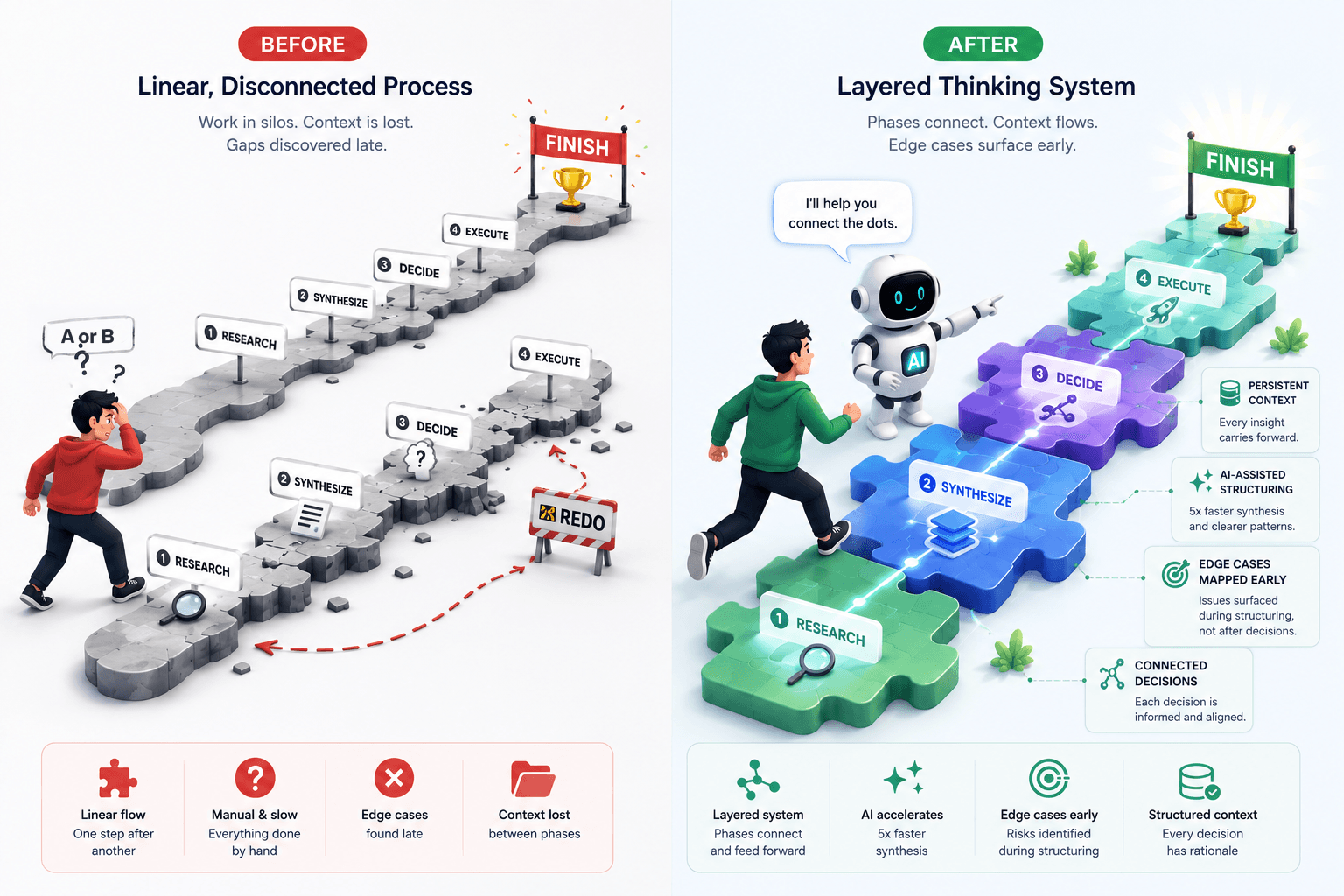
From linear process to Layered Thinking System
Question for the reader: Which one did you understand faster, the text or the infographic?
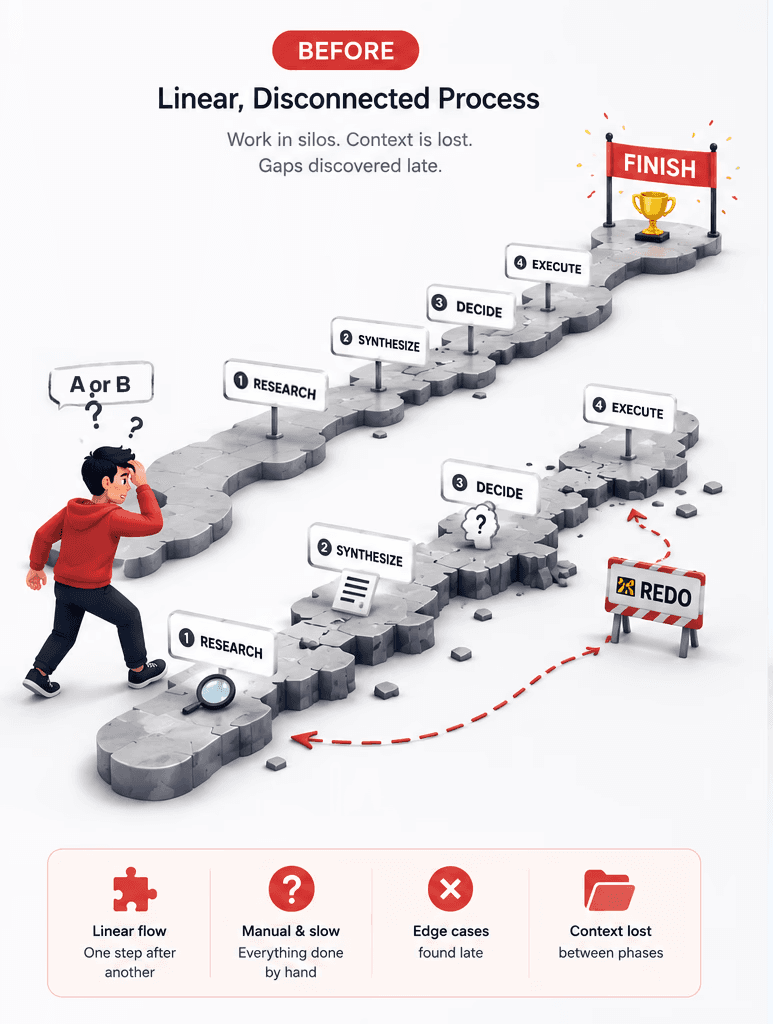
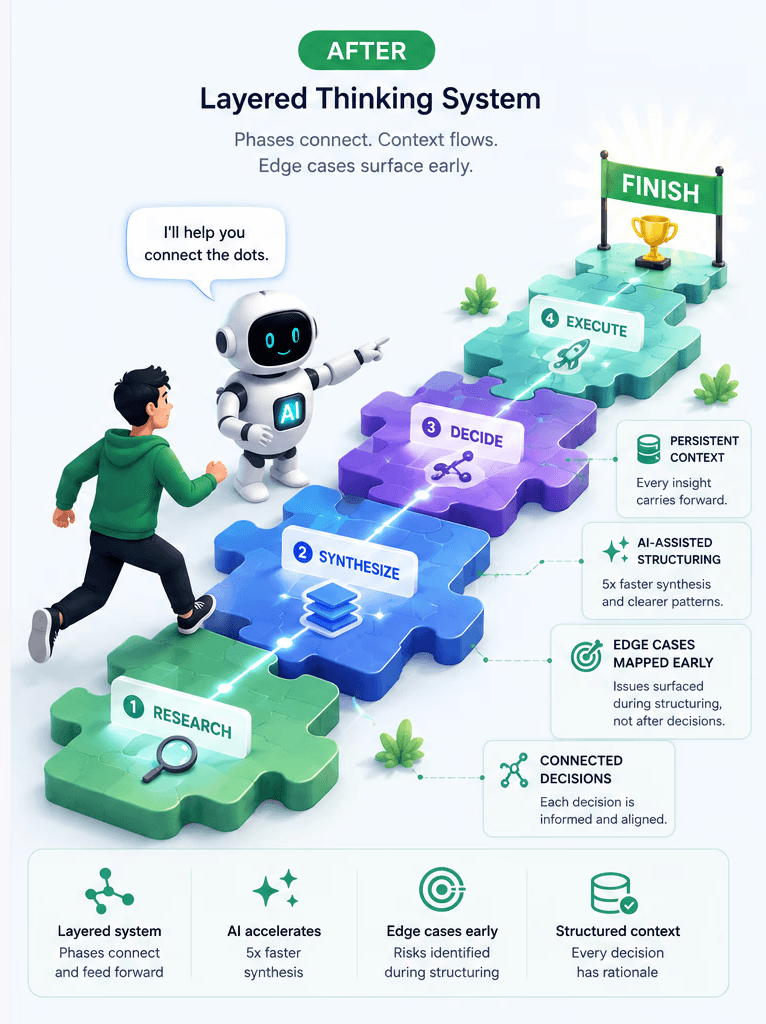
The change wasn't adopting AI tools. It was reorganizing how I process information - building a system where each phase feeds the next with structured context, not raw notes.
The Process
Five phases.
One continuous system.
01
EXPLORATION
Widening the lens before narrowing focus
Before any structure, I use AI to rapidly explore adjacent domains, generate visual references, and surface unexpected angles that manual research would miss. The goal is breadth - filtering comes later.
Generate diverse visual directions across multiple domains
Surface non-obvious analogies and unexpected patterns
Build a rich reference palette before applying any filter
05
ITERATION
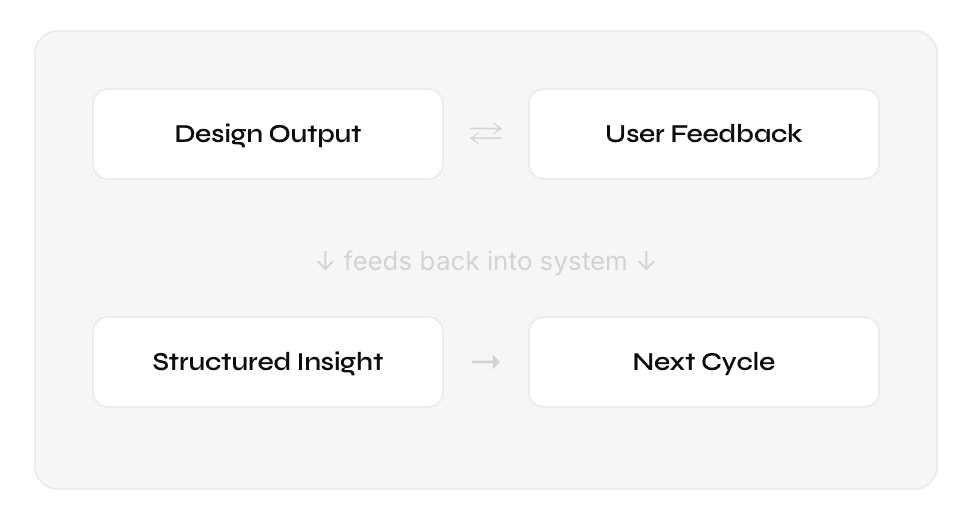
Feedback loops that feed the system
Iteration isn't the end — it feeds back into the system. Each cycle improves the structural inputs, making every subsequent project faster, more coherent, and more predictable.
Feedback is categorized and structured, not just collected
Patterns across cycles are tracked systematically
The system itself evolves with each project
04
EXECUTION
Building with annotated intent
Execution happens faster when the thinking is already structured. Each design decision carries the reasoning from earlier phases, embedded directly into the working files, not stored separately.
Decision rationale is always documented inline
AI-generated specs reduce annotation time significantly
Handoff becomes a byproduct of process, not a separate task
03
DEEP THINKING
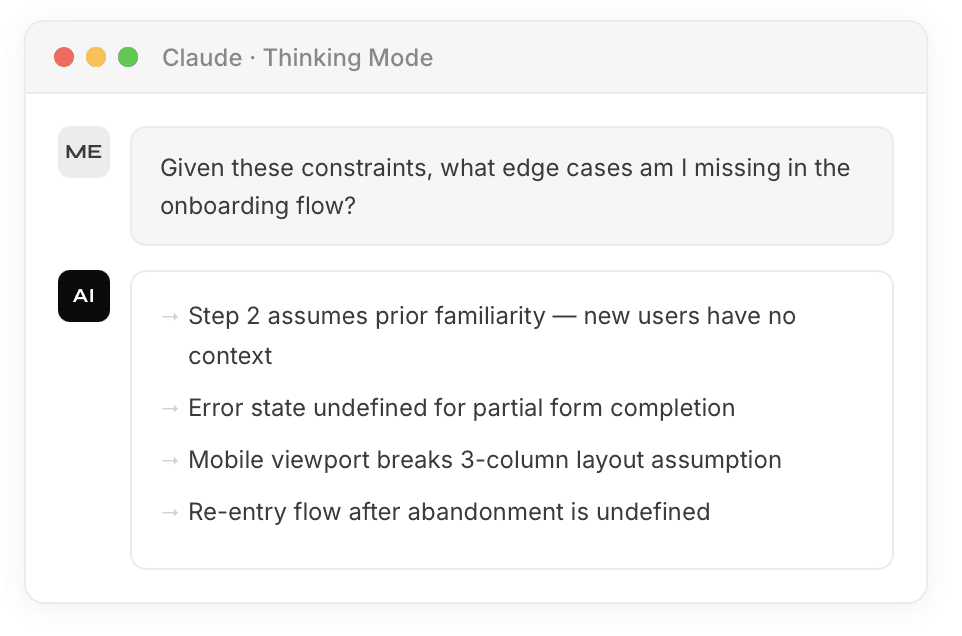
Deep thinking with Claude
This is the highest-leverage phase. I use Claude not to generate outputs, but to stress-test my thinking. Surfacing contradictions, edge cases, and unstated assumptions before they become design debt.
Pressure-test design rationale before committing
Map edge cases while reversals are still cheap
Generate structured briefs from rough, scattered context
02
STRUCTURING
Turning chaos into a decision tree
Raw inputs get organized into a decision-tree structure. AI helps me see the logical hierarchy hidden inside unstructured research and stakeholder feedback quickly, cleanly, without losing nuance.
Cluster insights into clear decision branches
Identify dependencies between constraints
Surface implicit assumptions before they become problems
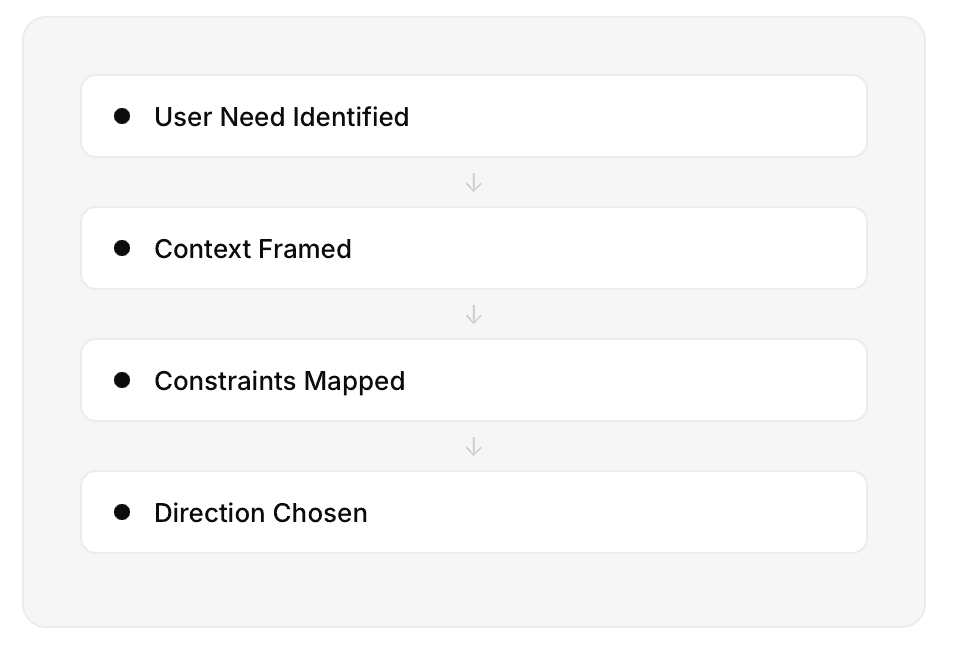
Solution: New System
01
EXPLORATION
Widening the lens before narrowing focus
Before any structure, I use AI to rapidly explore adjacent domains, generate visual references, and surface unexpected angles that manual research would miss. The goal is breadth - filtering comes later.
Generate diverse visual directions across multiple domains
Surface non-obvious analogies and unexpected patterns
Build a rich reference palette before applying any filter
01
EXPLORATION
Widening the lens before narrowing focus
Before any structure, I use AI to rapidly explore adjacent domains, generate visual references, and surface unexpected angles that manual research would miss. The goal is breadth - filtering comes later.
Generate diverse visual directions across multiple domains
Surface non-obvious analogies and unexpected patterns
Build a rich reference palette before applying any filter
Fragmented Journeys
Research, ideation, and execution operated in isolation with no connective logic between phases.
Unclear Requirements
Stakeholder needs arrived in fragments, never forming a coherent picture until late in the process.
Unmapped Edge Cases
Critical scenarios surfaced only after decisions were locked, creating expensive rework cycles.
Tight Timelines
Compressed schedules left no room for the exploratory thinking that separates good from great design.
AI hasn't replaced my design process
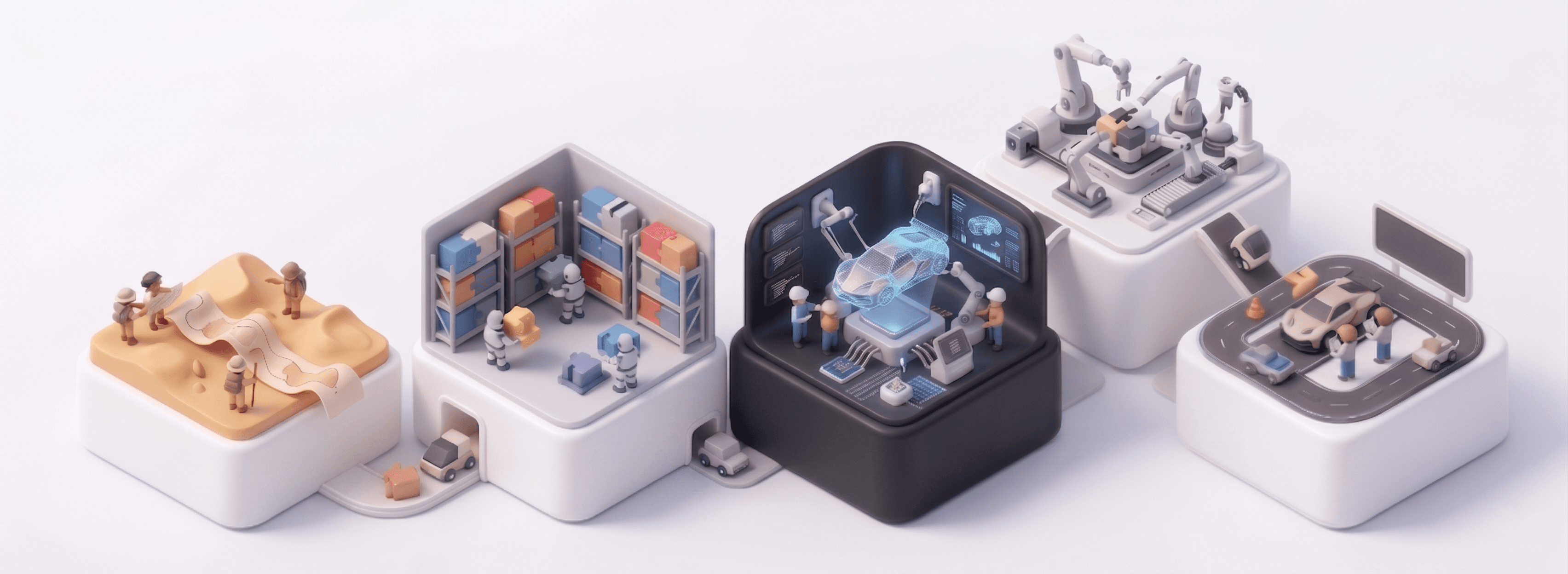
A design thinking pipeline powered by AI
Exploration
Widen before narrow
Structuring
Logic over lists
Thinking · Claude
Stress-test & surface
Execution
Build with intent
Iteration
Feedback feeds forward
Not a set of tools. A repeatable system, each phase structured to feed the next with clean, usable context.
AI hasn't replaced my role; it has expanded it
The shift isn't about using AI tools. It's about operating a design thinking system powered by AI;
one that makes every phase faster, deeper, and more connected than before.
AI hasn't replaced my role; it has expanded it
The shift isn't about using AI tools. It's about operating a design thinking system powered by AI;
one that makes every phase faster, deeper, and more connected than before.

AI hasn't replaced my design process
It has expanded it.
I use AI to move faster on execution, explore more directions, and focus deeper on design decisions that actually matter.
Let's dig in how AI helps me in my work
Building an AI-Powered Content Production Engine for Scalable Brand Marketing
The Race
Design work was fragmenting
faster than I could synthesize
Every project revealed the same structural gaps - disconnected phases, unclear requirements, untracked edge cases, and timelines that didn't survive contact with reality.
Fragmented Journeys
Research, ideation, and execution operated in isolation with no connective logic between phases.
Unclear Requirements
Stakeholder needs arrived in fragments, never forming a coherent picture until late in the process.
Unmapped Edge Cases
Critical scenarios surfaced only after decisions were locked, creating expensive rework cycles.
Tight Timelines
Compressed schedules left no room for the exploratory thinking that separates good from great design.
The Shift
From linear process to
Layered Thinking System
The change wasn't adopting AI tools. It was reorganizing how I process information - building a system where each phase feeds the next with structured context, not raw notes.
Question for the reader: Which one did you understand faster, the text or the infographic?
The Process
Five phases.
One continuous system.
01
EXPLORATION
Widening the lens before narrowing focus
Before any structure, I use AI to rapidly explore adjacent domains, generate visual references, and surface unexpected angles that manual research would miss. The goal is breadth - filtering comes later.
Generate diverse visual directions across multiple domains
Surface non-obvious analogies and unexpected patterns
Build a rich reference palette before applying any filter
02
STRUCTURING
Turning chaos into a decision tree
Raw inputs get organized into a decision-tree structure. AI helps me see the logical hierarchy hidden inside unstructured research and stakeholder feedback quickly, cleanly, without losing nuance.
Cluster insights into clear decision branches
Identify dependencies between constraints
Surface implicit assumptions before they become problems
03
DEEP THINKING
Deep thinking with Claude
This is the highest-leverage phase. I use Claude not to generate outputs, but to stress-test my thinking. Surfacing contradictions, edge cases, and unstated assumptions before they become design debt.
Pressure-test design rationale before committing
Map edge cases while reversals are still cheap
Generate structured briefs from rough, scattered context
04
EXECUTION
Building with annotated intent
Execution happens faster when the thinking is already structured. Each design decision carries the reasoning from earlier phases, embedded directly into the working files, not stored separately.
Decision rationale is always documented inline
AI-generated specs reduce annotation time significantly
Handoff becomes a byproduct of process, not a separate task
05
ITERATION
Feedback loops that feed the system
Iteration isn't the end — it feeds back into the system. Each cycle improves the structural inputs, making every subsequent project faster, more coherent, and more predictable.
Feedback is categorized and structured, not just collected
Patterns across cycles are tracked systematically
The system itself evolves with each project
Solution: New System
A design thinking pipeline powered by AI
Not a set of tools. A repeatable system, each phase structured to feed the next with clean, usable context.
Exploration
Widen before narrow
Structuring
Logic over lists
Thinking · Claude
Stress-test & surface
Execution
Build with intent
Iteration
Feedback feeds forward
AI Agent
Ship Products Faster Than Ever
Ship Products Faster Than Ever
Build, test, and launch in weeks, not months.

Automation
Scale Without Breaking Things
Scale Without Breaking Things
Grow confidently with infrastructure that adapts automatically.

AI hasn't replaced my role; it has expanded it
The shift isn't about using AI tools. It's about operating a design thinking system powered by AI;
one that makes every phase faster, deeper, and more connected than before.